


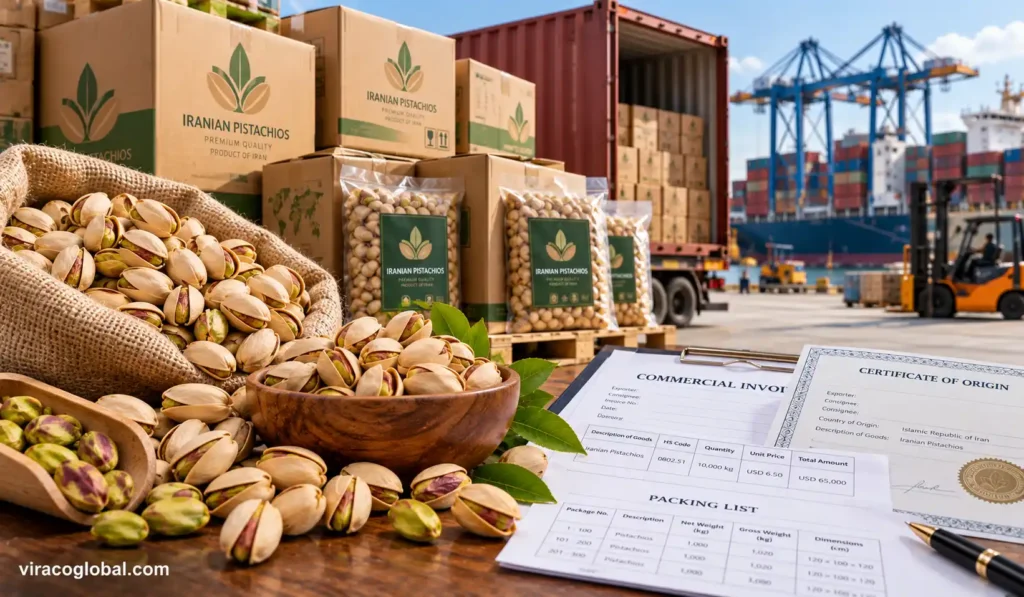
Buying Iranian pistachios in bulk can be an attractive sourcing opportunity for importers, wholesalers, food distributors, retailers, and food manufacturers. Iran is internationally known for producing pistachios with distinctive flavors, diverse varieties, and a wide range of commercial grades suitable for different markets.
However, successful bulk purchasing involves much more than simply comparing prices. Pistachio variety, size, opening type, moisture, aflatoxin levels, packaging, laboratory testing, export documentation, Incoterms, and supplier reliability can all affect the final quality and landed cost of a shipment.
For importers, the key is to define the required product specifications before requesting quotations. A clear specification allows suppliers to offer comparable prices and reduces the risk of receiving a product that does not meet the requirements of the destination market.
Why Are Iranian Pistachios Attractive to International Buyers?
Iranian pistachios have a long-standing reputation in international markets. One of their main advantages is the diversity of available varieties and commercial grades.
Depending on the target market, buyers can choose elongated premium pistachios, large round varieties, more economical commercial grades, or specific sizes for retail packaging and food manufacturing.
This flexibility makes Iranian pistachios suitable for several market segments, including premium retail, wholesale distribution, confectionery, bakery production, nut processing, and private-label products.
For international buyers, however, origin alone should never determine a purchasing decision. The actual specifications of the shipment are more important than the general reputation of the product.
Importers and distributors looking for products tailored to their destination market can use Viraco’s Iranian Pistachio Sourcing services to define specifications, evaluate sourcing requirements, and coordinate the procurement process.
Main Iranian Pistachio Varieties for Bulk Purchasing
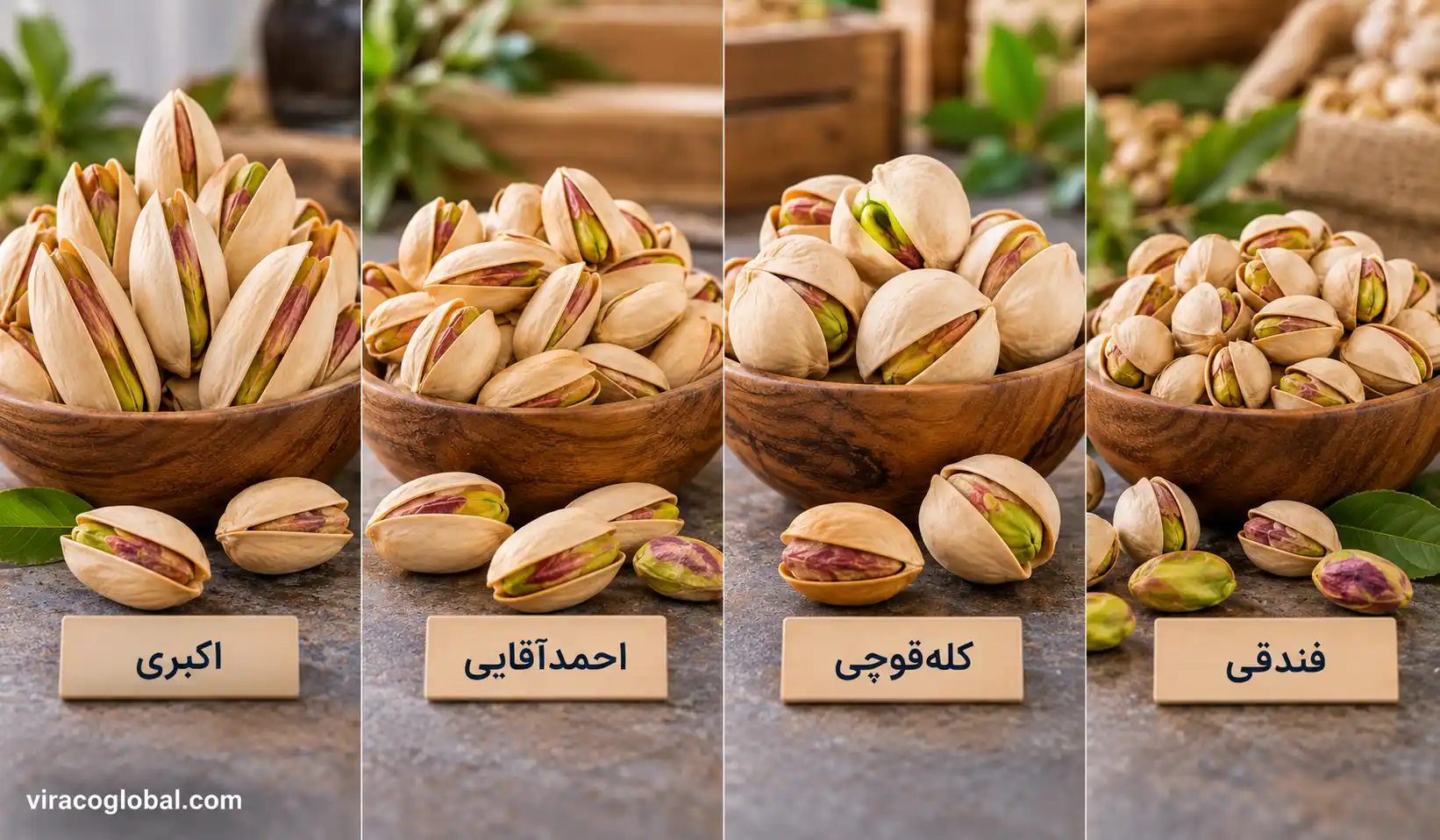
Iran produces several commercially important pistachio varieties. Four of the best-known options for international trade are Akbari, Ahmad Aghaei, Kalleh Ghouchi, and Fandoghi.
Each variety has different characteristics in terms of shape, appearance, size range, positioning, and potential use.
Akbari Pistachios
Akbari pistachios are known for their long and elegant shape. They are commonly positioned as a premium product and can be particularly attractive for markets where visual appearance and presentation are important.
They can be suitable for premium retail packaging, gift products, and higher-end nut segments.
Ahmad Aghaei Pistachios
Ahmad Aghaei is another elongated Iranian pistachio variety. Its attractive appearance and recognizable kernel color make it a popular option for both retail and wholesale applications.
It can provide buyers with a balance between visual appeal, commercial flexibility, and market positioning.
Kalleh Ghouchi Pistachios
Kalleh Ghouchi, often referred to internationally as Jumbo pistachio, has a larger and rounder appearance.
Its large nut size creates a strong visual presence, making it attractive for buyers whose customers associate larger pistachios with premium quality.
Fandoghi Pistachios
Fandoghi, also known as Round pistachio, is one of the most commercially versatile Iranian varieties.
Its smaller, round shape can make it suitable for larger-volume trading, wholesale distribution, retail packs, and markets where price competitiveness is particularly important.
Which Iranian Pistachio Variety Should an Importer Choose?
There is no single variety that is best for every market.
The right choice depends on the destination country, customer segment, expected retail price, packaging format, desired appearance, and the buyer’s commercial strategy.
For example, a premium retailer may prioritize large or elongated pistachios with strong visual appeal. A wholesaler serving a price-sensitive market may focus more heavily on cost efficiency and commercially available grades. A food manufacturer may prioritize kernel quality, consistency, food safety, and processing characteristics rather than shell appearance.
Therefore, before asking suppliers for a quotation, buyers should first determine exactly what their market requires.
Understanding Pistachio Size and Ounce Count
One of the most important specifications when buying pistachios in bulk is size.
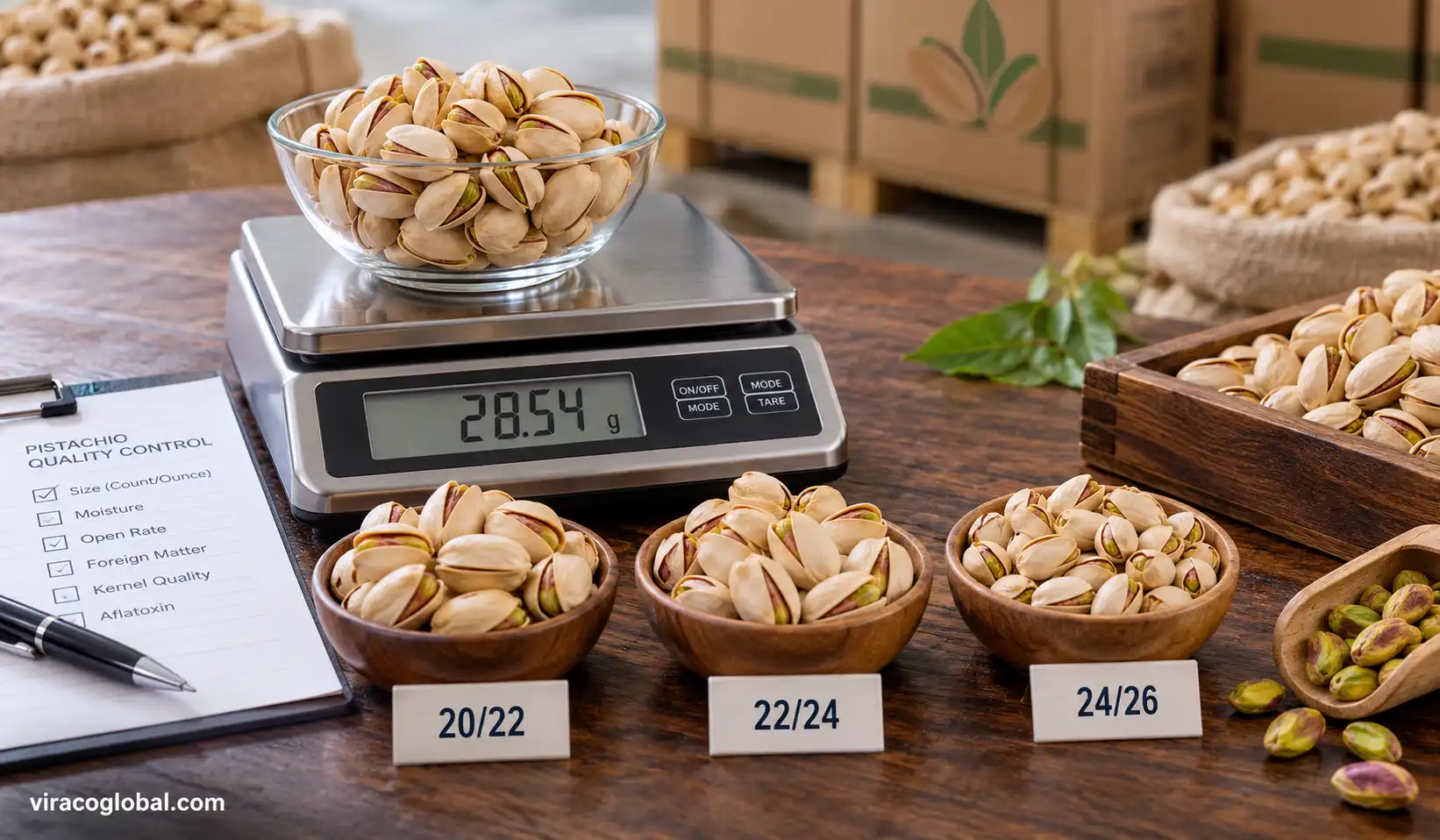
In international pistachio trading, size is commonly expressed using an ounce count such as:
- 20/22
- 22/24
- 24/26
- 26/28
- 28/30
These numbers generally indicate approximately how many pistachios make up one ounce.
A lower count usually corresponds to larger individual pistachios. Therefore, a 20/22 grade generally contains larger nuts than a 28/30 grade.
This distinction is important because two quotations for the same pistachio variety may represent different size grades and therefore should not automatically be compared as equivalent products.
Naturally Open vs. Mechanically Open Pistachios
Another important specification is whether the pistachios are naturally open or mechanically opened.
Naturally Open Pistachios
Naturally open pistachios split naturally during development and ripening. They are commonly preferred in markets where buyers place greater emphasis on natural appearance and premium positioning.
Mechanically Open Pistachios
Some closed-shell pistachios can be mechanically opened during processing.
These products may serve different commercial segments and price points, but the buyer should know exactly which opening type is being quoted.
This specification should therefore be clearly included in the purchase contract, proforma invoice, or product specification sheet.
Quality Specifications to Check Before Buying
A professional bulk pistachio order should not be based solely on variety and size.
Importers should define measurable quality specifications whenever possible.
Depending on the product and destination market, these may include:
- Pistachio variety
- Size or ounce count
- Naturally open or mechanically open
- Moisture level
- Closed-shell percentage
- Empty-shell percentage
- Broken or damaged nuts
- Foreign matter
- Kernel appearance
- Uniformity
- Crop year
- Packaging specifications
- Food safety requirements
- Microbiological specifications where applicable
- Aflatoxin requirements
The more clearly these parameters are defined before purchase, the easier it becomes to compare quotations from different suppliers.
Aflatoxin: A Critical Issue for Pistachio Importers
Aflatoxin control is one of the most important food-safety considerations in international pistachio trade.
Acceptable limits and testing requirements vary depending on the destination market and intended use. For that reason, importers should verify the applicable regulations in their own country before finalizing an order.
Buyers may need laboratory testing and supporting documentation demonstrating compliance with the required limits.
Rather than simply asking whether the product is “export quality,” professional buyers should request measurable specifications and relevant laboratory results.
This is especially important because failure to comply with destination-market food-safety requirements can lead to additional inspections, shipment delays, rejection, or significant financial losses.
Always Request a Sample Before a Large Order
Samples are an important part of B2B food sourcing.
Before placing a large commercial order, the buyer should request a representative sample whenever practical and evaluate it against the agreed specifications.
A sample can help assess characteristics such as size, shell appearance, kernel color, taste, odor, uniformity, visible defects, and packaging quality.
However, receiving a good sample is not enough. The purchase documents should clearly state that the commercial shipment must conform to the approved specifications or reference sample.
This creates a clearer basis for quality control when the final shipment is prepared.
Documents Required for Importing Iranian Pistachios
International pistachio shipments may require several commercial, transport, origin, and food-safety documents.
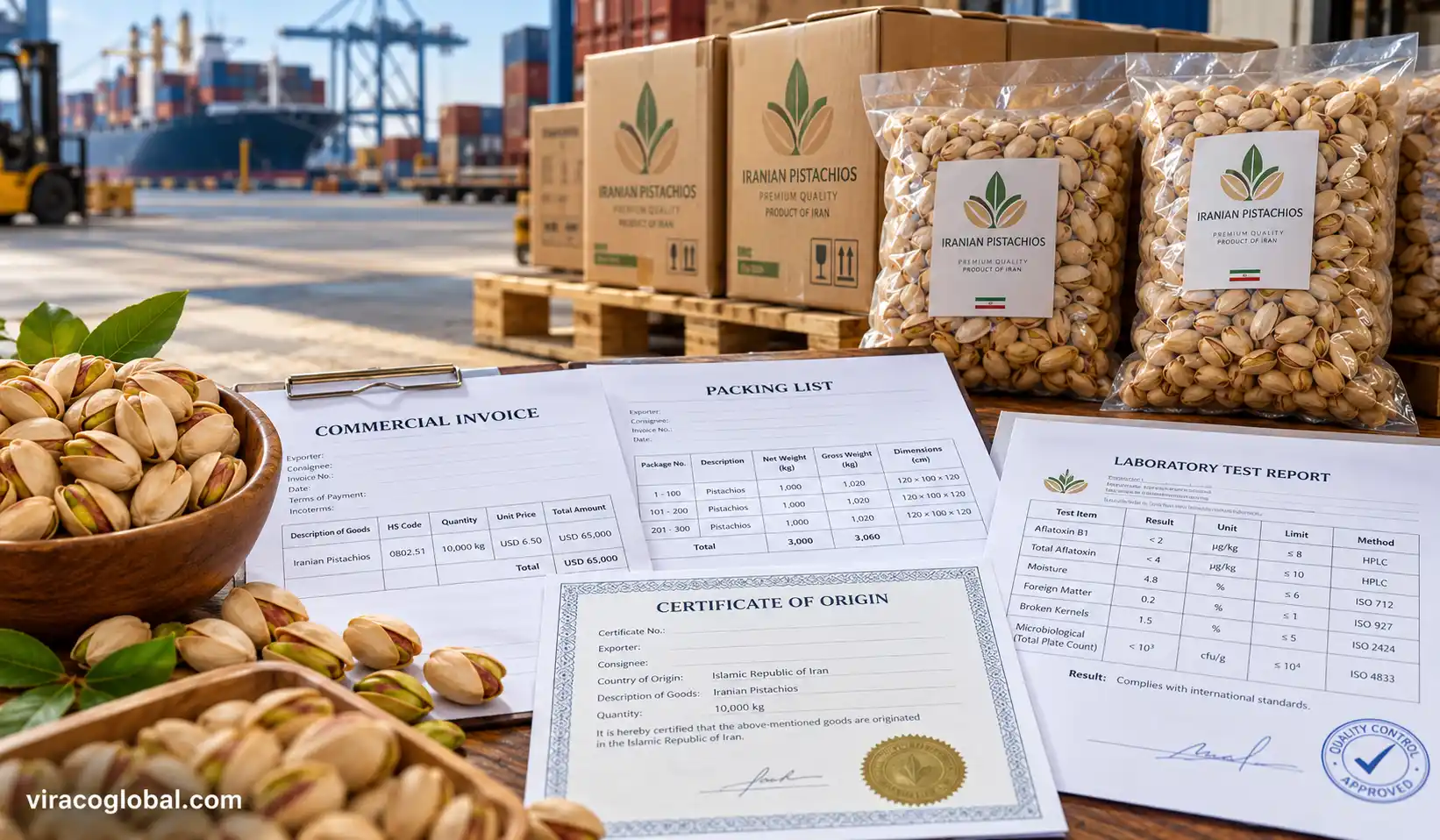
Depending on the destination country, transaction structure, and shipping method, commonly required documents may include:
Commercial Invoice: Specifies the seller, buyer, goods, quantity, value, payment terms, and other commercial details.
Packing List: Provides information about the number of packages, net and gross weight, packaging format, and shipment details.
Certificate of Origin: Identifies the declared origin of the goods.
Transport Document: Depending on the mode of transport, this may include a Bill of Lading, CMR, Air Waybill, or another relevant shipping document.
Laboratory Test Report: May provide results for parameters such as aflatoxin, moisture, microbiological characteristics, or other quality requirements.
Additional certificates may be required depending on the importing country’s regulations.
Importers should confirm documentary requirements with their customs broker, competent authorities, and relevant food-safety agencies before shipment.
Packaging Options for Bulk Iranian Pistachios
Packaging has a direct impact on product protection, logistics, storage, branding, and final cost.
For bulk trade, packaging may include bags, cartons, vacuum-packed formats, or other food-grade solutions depending on the buyer’s requirements.
Retail and private-label buyers may require smaller consumer packs with customized branding, while industrial buyers may prefer larger bulk formats.
Before confirming an order, the buyer should specify:
Packaging type, net weight per package, number of units, labeling requirements, palletization, private-label requirements, and any destination-market packaging regulations.
Good packaging is not simply a visual issue. It should help protect the product against moisture, contamination, physical damage, and quality deterioration throughout transport and storage.
What Determines the Wholesale Price of Iranian Pistachios?
There is no single wholesale price for Iranian pistachios.
The final quotation can vary significantly depending on several factors, including variety, size, quality grade, crop conditions, processing method, opening type, packaging, order volume, laboratory requirements, logistics, Incoterm, and market conditions.
For this reason, an importer should avoid comparing quotations based only on a price per kilogram.
A lower quotation may represent a different size, grade, opening type, packaging method, quality specification, or delivery term.
The correct approach is to compare like-for-like specifications.
EXW, FOB, CIF: Why Incoterms Matter
A pistachio quotation is incomplete if the delivery term is unclear.
For example, an EXW price cannot be directly compared with a CIF price because the responsibilities and included logistics costs are different.
Under EXW, the buyer generally assumes responsibility for a larger portion of the logistics process from the seller’s premises.
Under FOB, the seller’s responsibilities generally extend to delivering the goods on board the vessel at the agreed port of shipment.
Under CIF, the quoted price generally includes cost, insurance, and freight to the named destination port, subject to the applicable Incoterms rules and contract.
Importers should therefore ensure that every quotation clearly states the applicable Incoterm and named place or port.
Calculate Landed Cost, Not Just Product Price
For an importer, the real purchasing cost is not simply the supplier’s unit price.
The more meaningful figure is the landed cost: the total cost of bringing the product to the required destination.
Depending on the transaction, this can include the product price, export packaging, inland transportation, export-related charges, international freight, insurance, customs duties, taxes, customs clearance, inspections, handling, storage, and local delivery.
A supplier offering a slightly lower product price may not necessarily provide the lowest landed cost.
Professional procurement decisions should therefore evaluate the entire supply chain.
How to Evaluate an Iranian Pistachio Supplier
Supplier evaluation is one of the most important stages of bulk sourcing.
Importers should assess not only whether a supplier can offer pistachios, but whether that supplier can consistently meet the required specifications and support an international transaction.
Important areas to evaluate include:
- Experience with international orders
- Ability to provide clear product specifications
- Product traceability
- Quality-control procedures
- Laboratory testing capabilities
- Packaging options
- Export documentation
- Production or supply capacity
- Communication and response quality
- Ability to provide representative samples
- Consistency between sample and commercial shipment
- Agreed delivery schedule and terms
A reliable supplier should be able to answer technical and commercial questions clearly rather than relying only on broad claims such as “premium quality.”
What Should Be Included in a Pistachio RFQ?
A detailed RFQ — Request for Quotation — helps buyers receive more accurate and comparable offers.
Instead of writing:
“Please send your best price for Iranian pistachios.”
A professional buyer can provide:
Product: Iranian Pistachios
Variety: Akbari / Ahmad Aghaei / Kalleh Ghouchi / Fandoghi
Size: e.g. 22/24
Opening: Naturally Open
Quantity: e.g. 10 MT
Packaging: e.g. 10 kg cartons
Destination: Country / Port
Required Tests: According to destination-market requirements
Incoterm: EXW / FOB / CIF
Private Label: Yes / No
Required Documents: Specify according to import requirements
The more complete the RFQ, the easier it becomes to obtain commercially useful quotations.
Common Mistakes When Buying Iranian Pistachios in Bulk
One common mistake is choosing a supplier based only on the lowest price. A low price may reflect differences in size, grade, opening type, crop quality, packaging, or commercial terms.
Another mistake is failing to define quality specifications before placing the order. Terms such as “premium,” “Grade A,” or “export quality” can be interpreted differently unless they are supported by measurable criteria.
Importers may also overlook destination-country food regulations until the shipment is already in transit. Food-safety limits, labeling requirements, documentation, and customs procedures should be reviewed before purchase.
Other risks include approving an order without a representative sample, failing to clarify Incoterms, comparing non-equivalent quotations, and overlooking total landed cost.
Bulk Iranian Pistachio Purchasing Checklist
Before confirming a commercial order, importers should verify the following:
Product: Which pistachio variety is required?
Size: What ounce count or grading specification is needed?
Opening: Naturally open or mechanically open?
Quality: Have moisture, defects, foreign matter, and other parameters been defined?
Aflatoxin: Are destination-market limits and testing requirements clear?
Sample: Has a representative sample been evaluated?
Packaging: Is the packaging suitable for transport, storage, and the final market?
Documents: Are all required commercial, transport, origin, and food-safety documents available?
Incoterm: Is the delivery term and named place clearly specified?
Logistics: Has the shipping method and route been evaluated?
Landed Cost: Have all costs beyond the supplier’s unit price been considered?
Supplier: Has the supplier’s ability to meet the agreed specifications been assessed?
Iranian Pistachio Sourcing for International Markets
Bulk pistachio sourcing involves several interconnected decisions. Selecting the variety is only the beginning. Buyers must also determine size, quality specifications, testing requirements, packaging, documentation, logistics, and commercial terms.
A structured sourcing process can reduce uncertainty and help buyers compare suppliers on a more consistent basis.
For importers, distributors, wholesalers, and companies seeking Iranian pistachios for international markets, Viraco’s Iranian Pistachio Sourcing for Export service can support the process from defining product requirements and sourcing specifications to coordinating procurement and international trade requirements.
Conclusion
Buying Iranian pistachios in bulk should be approached as a professional sourcing process rather than a simple price comparison.
Variety, ounce count, opening type, quality specifications, aflatoxin control, packaging, documentation, Incoterms, supplier reliability, and landed cost can all influence the success of an import transaction.
For international buyers, the most effective approach is to define the required specifications first, request comparable quotations, verify product quality, review destination-market requirements, and only then finalize the commercial order.
This approach makes it easier to source Iranian pistachios that match both the technical requirements and commercial expectations of the target market.
FAQ
There is no single best variety. Akbari, Ahmad Aghaei, Kalleh Ghouchi, and Fandoghi serve different market segments. The best choice depends on the target market, required appearance, size, price positioning, and intended use.
These numbers refer to an ounce-count grading system. In general, a lower count indicates larger individual pistachios.
Naturally open pistachios split naturally during development, while mechanically open pistachios are opened through processing. Buyers should specify which type they require before requesting a quotation.
Aflatoxin is an important food-safety parameter, and permitted limits can vary between destination markets. Non-compliance may result in inspections, delays, rejection, or financial losses.
Requirements vary by destination, but documents may include a Commercial Invoice, Packing List, Certificate of Origin, transport documents, and relevant laboratory or food-safety certificates.
Yes. A representative sample helps buyers evaluate the product before committing to a larger commercial shipment. The final order specifications should also clearly define the required quality.
Price can be affected by variety, size, grade, opening type, crop conditions, packaging, quantity, testing requirements, logistics, and Incoterms.
Quotations should be compared using equivalent specifications. Variety, size, quality, packaging, quantity, testing requirements, Incoterm, and destination should all be considered rather than comparing only the price per kilogram.